
Beyond Open Loop and Closed Loop: Introducing the Shared Loop
A new settlement model for transit and mobility payments
For decades, transit agencies and city planners have been forced to choose between two imperfect payment models: Closed Loop and Open Loop.
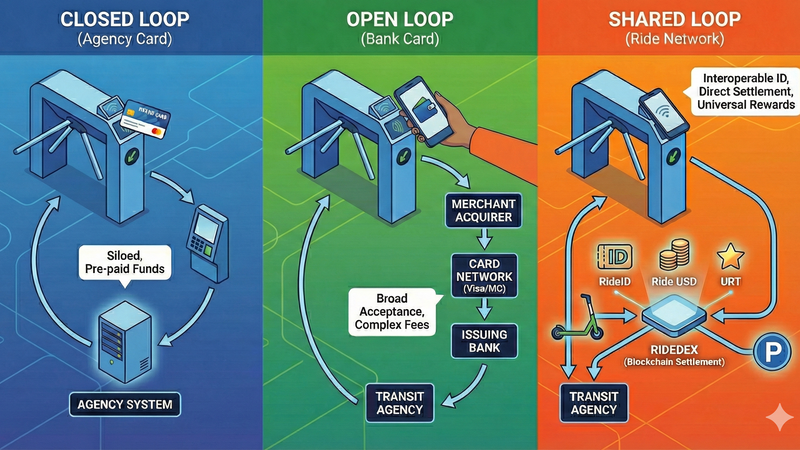
In a Closed Loop system, such as agency-issued transit cards, operators have greater control over fare collection and customer relationships. Instead of paying processing fees on every ride, agencies typically incur payment processing costs only when riders initially load value onto their accounts, rather than on each individual trip. This can reduce per-ride transaction costs and provide more predictable fare economics.
However, Closed Loop systems also require significant investment in proprietary infrastructure, including card production, retail distribution networks, account management systems, and customer support. Riders must obtain and maintain a separate transit credential, which can create friction - particularly for visitors and occasional users who may prefer to use payment methods they already carry.
In an Open Loop system, riders can simply tap their existing Visa, Mastercard, or mobile wallet at the turnstile. Convenience improves dramatically, reducing barriers to entry and improving rider satisfaction. However, Open Loop introduces a different challenge.
Credit card networks were designed for larger retail purchases, not high-frequency, low-value transit fares. Fixed and percentage-based processing fees can consume a meaningful portion of each fare, while settlement delays can slow cash flow and add reconciliation complexity. At scale, these fees represent millions of dollars annually for large transit systems.
For years, transit agencies have been forced to choose between control and efficiency or convenience and accessibility.
But a third model is now emerging. It’s called the Shared Loop.
The Shared Loop is a model where identity, settlement, and incentives operate on shared infrastructure rather than being siloed within individual transit systems or legacy payment networks. It combines the cost efficiency of closed-loop systems with the convenience of open-loop payments, while introducing new capabilities designed specifically for modern mobility.
Metroblox is introducing the Shared Loop to provide transit agencies with a purpose-built financial infrastructure for the next generation of transportation.
The Shared Loop is built on three foundational pillars: Portable Identity, Modern Settlement, and Universal Incentives.
Portable Identity: A Rider-Controlled Mobility Credential
In traditional systems, every transit agency, micromobility provider, parking operator, and toll system requires riders to create separate accounts. Each organization stores sensitive personal and payment information, increasing cybersecurity risk, compliance burden, and operational overhead.
The Shared Loop introduces RideID, a portable digital mobility credential.
RideID allows riders to create a single secure identity that can be used across participating mobility services.
For riders, this means a simpler experience. They can access transit, parking, and other services without repeatedly creating new accounts.
For agencies, this reduces the need to store sensitive financial information while still allowing them to authenticate riders and understand system usage.
Identity becomes portable, secure, and interoperable.
Modern Settlement: Purpose-Built Financial Infrastructure for Mobility
Identity enables access but settlement powers the system.
In Open Loop systems, a single tap triggers a complex chain of intermediaries, including acquiring banks, processors, and card networks. Each layer adds cost, delay, and operational complexity.
The Shared Loop introduces RideUSD, a fully reserved digital dollar settlement asset designed specifically for mobility payments.
When a rider taps to pay, settlement occurs directly within the Shared Loop infrastructure.
This provides several key advantages:
-
Near-instant settlement instead of multi-day reconciliation cycles
-
Lower transaction costs by reducing intermediary fees
-
Improved cash flow and financial visibility for operators
-
The same seamless tap-and-go experience riders expect
Importantly, the Shared Loop can operate alongside existing payment systems, allowing agencies to adopt modern settlement infrastructure incrementally without disrupting current rider experiences.
Settlement becomes faster, more efficient, and aligned with the economics of transit.
Universal Incentives: A Network-Wide Rewards Layer
When identity and settlement operate on shared infrastructure, a powerful new capability emerges: interoperable incentives.
Historically, transit rewards programs have been limited in scope because they operate in isolation.
The Shared Loop introduces the Universal Ride Token (URT), a fully backed rewards asset that can be funded by third parties and applied across the mobility network.
External partners - including employers, cities, universities, and local businesses—can fund incentives directly into the system.
Riders earn rewards for eligible behavior, such as commuting by transit, traveling during off-peak hours, or choosing sustainable transportation.
When the rider taps to pay, rewards are automatically applied to reduce the cost of the trip, while the operator receives full, guaranteed fare revenue.
This creates a powerful alignment:
-
Riders benefit from lower transportation costs
-
Transit agencies receive fully funded fares
-
Cities and partners gain tools to influence mobility behavior
-
Incentives become programmable, targeted, and scalable.
The Shared Loop: A New Foundation for Mobility Payments
The Shared Loop represents an evolution beyond both Closed Loop and Open Loop systems. It combines:
-
The cost efficiency of Closed Loop
-
The convenience of Open Loop
-
And introduces a shared settlement and incentives layer designed for mobility
By modernizing identity, settlement, and incentives, the Shared Loop provides transit agencies with greater financial efficiency, faster access to revenue, and new opportunities to attract and retain riders.
Mobility payments are no longer confined to isolated systems. They can operate on shared infrastructure.
The future of transit payments will not be defined by closed systems or legacy financial networks. It will be defined by infrastructure designed specifically for mobility.
That future is the Shared Loop.
About Metroblox
Metroblox is a financial infrastructure company focused on modernizing payments and incentives for transportation. The company has developed the Ride Ecosystem, which includes RideUSD, a digital payment & settlement asset, and the Universal Ride Token, a network-wide incentives layer designed to help transit agencies reduce costs, accelerate settlement, and unlock new funding sources for rider incentives.
Metroblox is working with transit agencies, cities, and mobility providers to pilot the Shared Loop and demonstrate how modern settlement infrastructure can improve transit economics while enhancing the rider experience.
Invitation to Pilot
Metroblox is currently partnering with forward-thinking transit agencies and mobility operators, as well as solution providers to launch pilot programs.
These initial pilots are designed to:
-
Reduce payment processing costs
-
Accelerate settlement and improve cash flow
-
Enable fully funded rider incentive programs
-
Operate alongside existing fare systems
Agencies interested in participating in a pilot program can contact Metroblox to learn more. Join us to help shape the future of mobility payments.